The College of Dental Surgeons of Alberta offers a Supportive Pathway Program for Internationally Trained Dentists (ITDs) from non-accredited undergraduate dental programs. This pathway is designed to support ITDs pursuing the National Dental Examining Board (NDEB) certification while exposing them to the Canadian dental profession.
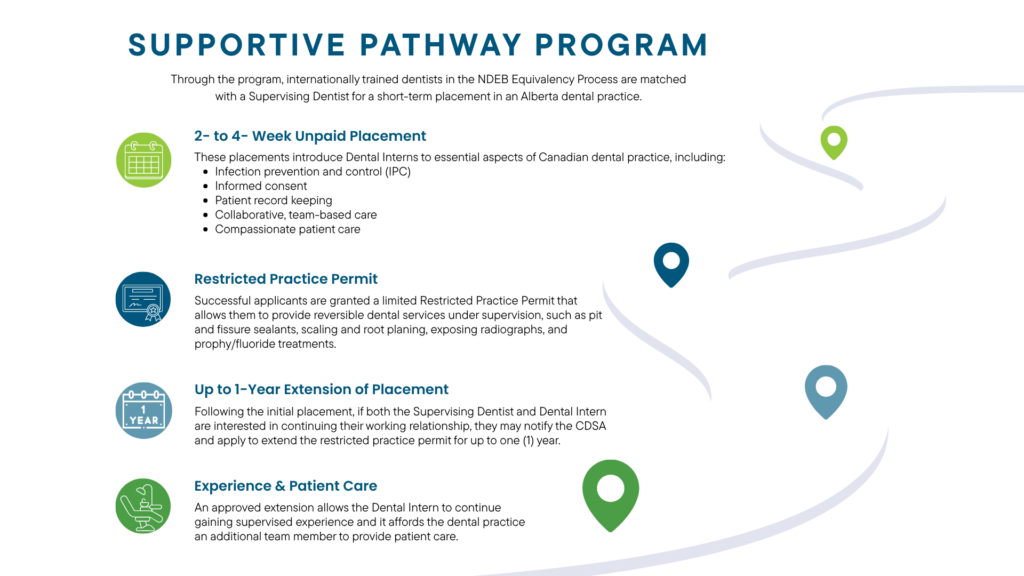
Through the program, internationally trained dentists in the NDEB Equivalency Process are matched with a Supervising Dentist for a short-term placement in an Alberta dental practice. During this time, Dental Interns are granted a limited Restricted Practice Permit that allows them to provide reversible dental services under supervision, such as pit and fissure sealants, scaling and root planing, exposing radiographs, and prophy/fluoride treatments.
The program has recently been enhanced and is now open to all Alberta dental practices, centering on a two (2) to four (4) consecutive week unpaid placement designed to be observational and supportive in nature.
These placements introduce Dental Interns to essential aspects of Canadian dental practice, including:
Infection prevention and control (IPC)
Informed consent
Patient record keeping
Collaborative, team-based care
Compassionate patient care
The initial placement is intended to be short term (2- to 4- consecutive weeks). Following the placement, if both the Supervising Dentist and Dental Intern are interested in continuing their working relationship, they may notify the CDSA and apply to extend the restricted practice permit for up to one (1) year. An approved extension allows the Dental Intern to continue gaining supervised experience and it affords the dental practice an additional team member to provide patient care.
The Supportive Pathway Restricted Registration Permit is limited to practice within Alberta and is not portable within Canada.
ITDs are required to continue the NDEB Equivalency Process while within the CDSA’s Supportive Pathway Program. The Supportive Pathway Program is not an alternative to the NDEB Equivalency Process.
Supervising Dentist Applicants
Below you will find requirements of a Supervising Dentist application to the Supportive Pathway Pilot Program.
Supportive Pathway Application
Application Requirements
Hold a current, unrestricted practice permit as a General Dentist in Alberta.
Be in good standing with the College.
Practicing for a minimum of five (5) years.
Maintain a clinical practice facility equipped with the necessary infrastructure to provide a supportive learning environment.
A willingness to actively supervise and guide individuals, fostering their professional development and integration into the Alberta Dental Profession.
Ensure impartiality by disclosing any potential conflicts of interest.
Be actively engaged at the practice. Although the mentorship is intended to be one on one, the responsibility of supervision can be shared with other dentists at the practice.
Upon Successful Application
Supervising Dentists will:
Attend a virtual interview with the Supportive Pathway Committee and the Registrar.
Successful Applicant Requirements
Supervising Dentists will be accepted into the Supportive Pathway Pilot Program and be placed on a roster to be matched with an Internationally Trained Dentist.
Upon acceptance, all Supervising Dentists and ITDs will be required to attend a Supportive Pathway Orientation.
Participation during Supportive Pathway Program
Responsibilities of the Supervising Dentist
Promote Integration
Facilitate the smooth integration of the ITD into the workplace, ensuring they are informed about the facility’s operations and available resources.
Work within a supervised clinical practice model
Clearly define the ITD’s tasks, outlining working methods and objectives to guide their performance and help them organize their responsibilities.
Introduce ITDs to your management practices.
Patient Care and Record Keeping
Allow the ITD to perform restricted activities as defined by their restricted practice permit, while providing appropriate guidance and support to ensure patient care is delivered safely and thoroughly documented.
Confidentiality and Ethics
Guide the ITD in ensuring patient confidentiality and high ethical standards are maintained in all aspects of patient care.
Completion of the two (2) to four (4) Consecutive Week Supportive Pathway Placement
Completion of two (2) to four (4) Consecutive Week Placement for Supervising Dentists:
If the initial placement is not extended, the Dental Intern’s Restricted Practice Permit is no longer valid, and they may not provide services to patients in the practice.
Remain on the roster as a Supervising Dentist for the potential to be matched with another Dental Intern.
Up to 1-Year Extension of Placement
Following the placement, if both the Supervising Dentist and Dental Intern are interested in continuing the working relationship, they may notify the CDSA and apply to extend the restricted practice permit for up to one (1) year. An approved extension allows the Dental Intern to continue gaining supervised experience and affords the dental practice an additional team member to provide patient care.
Independent practice is not permitted. Services must be provided within the assigned dental practice.
The Restricted Practice Permit is not portable within Canada.
ITDs must be actively pursuing NDEB Certification throughout the 1-year extension period.
Below you will find requirements of an ITD application to the Supportive Pathway Pilot Program, responsibilities following application acceptance, responsibilities during placement, and an outline of successful completion of the program.
Supportive Pathway Application
Application Requirements
Approved application and acceptance to the NDEB Equivalency Process.
Successful completion of the NDEB Assessment of Fundamental Knowledge (AFK).
Successful completion of the NDEB Assessment of Clinical Judgement (ACJ) within the last three (3) years.
Submit Application and Documentation:
Complete and submit the application form provided by the College.
Ensure all required supporting documents are included as per the application guidelines.
Pay the Supportive Pathway Application Fee of $500 (non-refundable). The Application fee is valid for two years.
English Language Proficiency: The ITD must demonstrate proficiency in English, meeting the requirements outlined in the CDSA English Language Proficiency Policy RP-01. Applicants currently in an active registration with another Alberta Oral Health Regulator (Hygienist, Dental Assistant, Denturist, Technologist) are considered to have met the requirements for English Language Proficiency.
An English language proficiency test is required when:
There is no equivalent English proficiency requirement in the jurisdiction where the applicant is currently or has been registered.
The dental school or postgraduate dental education program was conducted in a language other than English.
Applicants who are required to demonstrate English language proficiency must complete an academic version of an English language proficiency test within 24 months before applying for registration.
Be a Canadian Citizen, a Permanent Resident of Canada, or authorized as lawfully permitted to work in Canada. Preference will be given to applicants currently living in Alberta.
Proof of current Basic Life Support (HCR/CPR) including AED equivalent certification within the last twelve (12) months.
Be willing to potentially relocate to a dental practice within Alberta for the duration of the two (2) to four (4) consecutive week placement.
Meet any other criteria as determined by the Registrar, ensuring that all necessary qualifications, standards, and competencies are met to provide safe and effective care.
A completed application does not guarantee admittance into the Supportive Pathway Program.
Upon Successful Application
ITDs will:
Write the CDSA Ethics and Jurisprudence Exam
Attend a virtual interview with the Supportive Pathway Committee and the Registrar
Successful Applicant Requirements
Applicants will be accepted into the Supportive Pathway Pilot Program based on Supervising Dentist availability.
Upon acceptance, all ITDs and Supervising Dentists will be required to attend a Supportive Pathway Orientation.
Restricted Practice Permit Information
Applicants accepted to the Supportive Pathway Program will be issued a Restricted Practice Permit on the Main Register. This permit will specify:
Permitted Restricted Activities
The Restricted Permit allows for reversible dental services such as: exposing radiographs, scaling and root planing, prophy/fluoride, etc.
The Restricted Permit does not allow for any irreversible procedures such as: endodontic, restorative, surgical, etc.
Restrictions on Portability
The Restricted Practice Permit is limited to practice in Alberta and is not portable within Canada.
Supervision requirements
Participation during Supportive Pathway Program
Responsibilities of ITDs
Adhere to Legal and Regulatory Standards
Comply with CDSA Standards of Practice, the Code of Ethics, as well as any other relevant legislative requirements to ensure safe and competent practice.
Confidentiality and Ethics
Uphold patient confidentiality and maintain high ethical standards in all aspects of patient care, respecting privacy and dignity always.
Completion of the two (2) to four (4) Consecutive Week Supportive Pathway Placement
Completion of two (2) to four (4) Consecutive Week Placement for ITDs
If the initial placement is not extended, the Restricted Practice Permit is no longer valid.
Up to 1-Year Extension of Placement
Following the placement, if both the Supervising Dentist and Dental Intern are interested in continuing the working relationship, they may notify the CDSA and apply to extend the restricted practice permit for up to one (1) year. An approved extension allows the Dental Intern to continue gaining supervised experience and affords the dental practice an additional team member to provide patient care.
Independent practice is not permitted. Services must be provided within the assigned dental practice.
The Restricted Practice Permit is not portable within Canada.
ITDs must be actively pursuing NDEB Certification.
Supportive Pathway Fees
Required Fees
Supportive Pathway Application Fee: $500, non-refundable. The Application fee is valid for two years.
If the placement extends beyond the initial two (2) to four (4) consecutive weeks, there will be a requirement to pay the Liability Insurance portion of the Practice Permit Fee:
Fee: $1,535
Internationally Trained Dentist Applications are not currently open. Applications will open in late summer 2026.
Questions?
For any questions, we invite you to contact the CDSA’s Supportive Pathway department by email, at SupportivePathway@cdsab.ca